AI2 Research Laboratory
AI2 stands for Artificial intelligence (A), Interactive (I), Augmented (A), and Immersive (I) learning environments. AI2 represents the innovative learning environments we pursue to advance more adaptable, engaged, equitable, and effective teaching and learning in various educational contexts. We build on the legacy of our understanding of how people learn to answer the question, how we can scaffold people to learn better. Our endeavor to promote AI2 learning is driven by our belief that most learners can achieve learning goals if provided with appropriate instructional support.
Dr. Kim presented a talk for the NSF AI ALOE Virtual Discussions
March 16, 2026
This presentation, entitled "Contributions to Theories of Learning: Discussions on Open-Ended Problems," examines contributions to theories of learning through the lens of the SMART platform, with a particular focus on open-ended problems.
.. Read More
Dr. Kim presented at the Capitol.
February 19, 2026
Dr. Kim and researchers from the Byrdine F. Lewis College of Nursing and Health Professions showcased an AI simulation project as part of Georgia State University’s Research Day at the Capitol.
.. Read More
Our lab members provided a pre-conference workshop for SNRS.
February 18, 2026
Associate Professor Min Kyu Kim, doctoral students Jinho Kim and Seora Kim and faculty from the Byrdine F. Lewis College of Nursing and Health Professions presented at the Southern Nursing Research Society Annual Conference pre-conference workshop entitled “Optimization of AI Integration for Nursing Education and Research" at the Southern Nursing Research Society Annual Conference.
.. Read More
AI-Powered Multimodal Analytics of Learner Dynamics in Learner-Centered Activities
Learner-centered learning environments encourage autonomy, collaboration, and creative problem-solving, but they also present challenges in understanding how students engage and progress individually. This project leverages AI-driven multimodal analytics to examine learners’ dynamics using video data collected from a learner-centered classroom, focusing on how learners interact with peers, tools, and tasks. By using computer vision, machine learning techniques, and multimodal large language models (MLLMs), the project aims to detect key events such as collaboration, focus shifts, tool use, and moments of guidance-seeking. The ultimate goal is to develop an AI model that supports timely and personalized feedback, offering instructors and learners deeper insights into the learning process and helping to shape more responsive educational practices.
AI-Powered Multimodal Hybrid Instruction for Growth in Nursing Simulation (AIM HIGH-SIM)
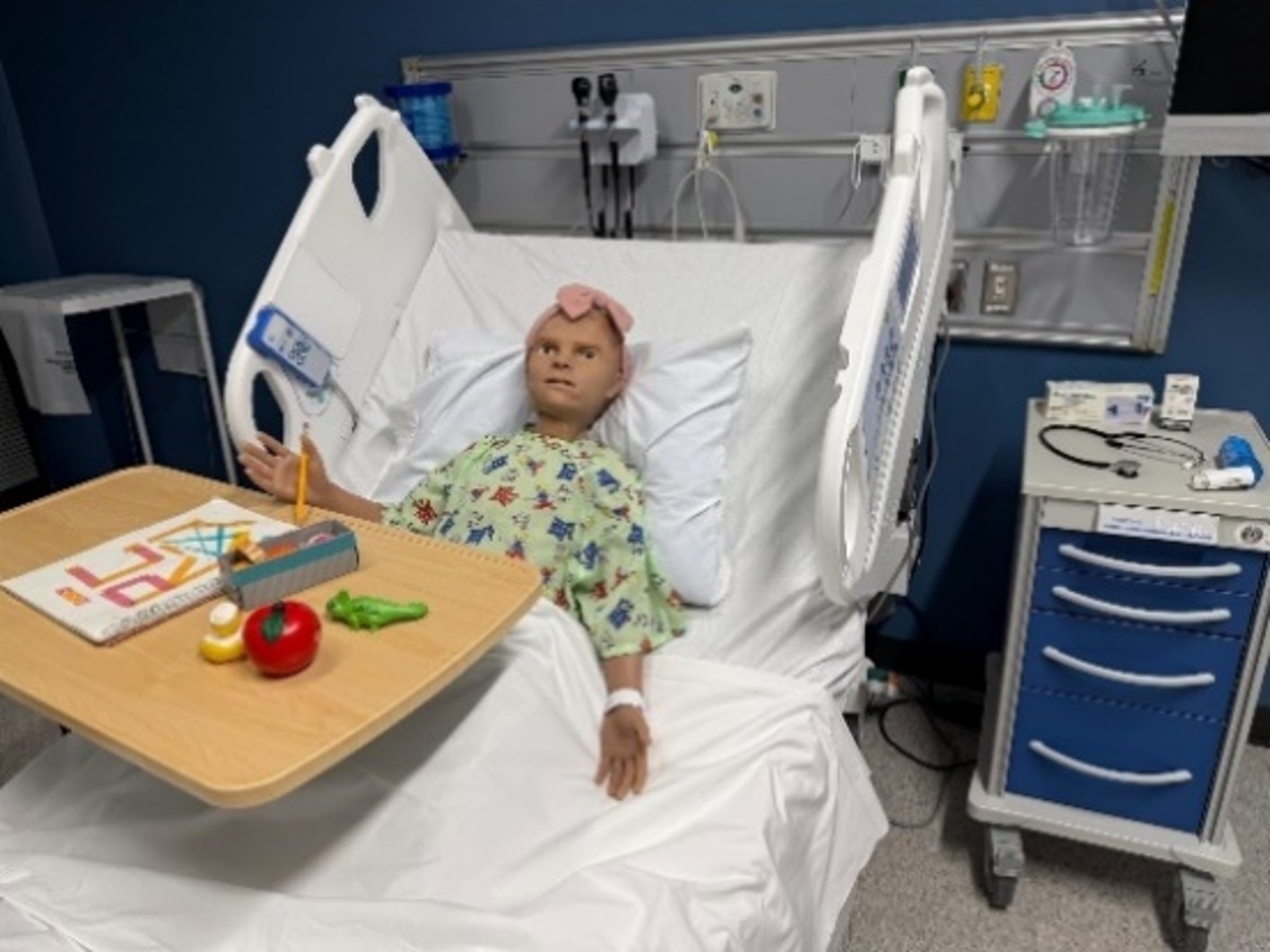
Simulation-based learning plays an important role in nursing education but often faces challenges due to being resource-intensive, which limits accessibility and scalability. The AIM HIGH-SIM project, in collaboration with the School of Nursing at Georgia State University, aims to establish a flexible framework for facilitating simulation-based learning through a conversational AI-augmented simulator. This framework will provide instructors the flexibility to easily add scenario cases along with related assessment criteria. These scenarios will support learners in practicing simulations within physical simulation rooms as part of their nursing education, with assessments drawn from both dialogue interactions and visual data within the simulation space. The system will provide personalized feedback, supporting both simulation centers and individual practice. By leveraging the capabilities of AI and structured framework design, the project enables learners to continuously practice and refine critical thinking and communication skills in a realistic, flexible, and authentic environment.
NSF IUSE-Engaged Student Learning (Level 1): AI-Scaffolded Pre-Classroom Learning for Large/Introductory Undergraduate Physics Courses
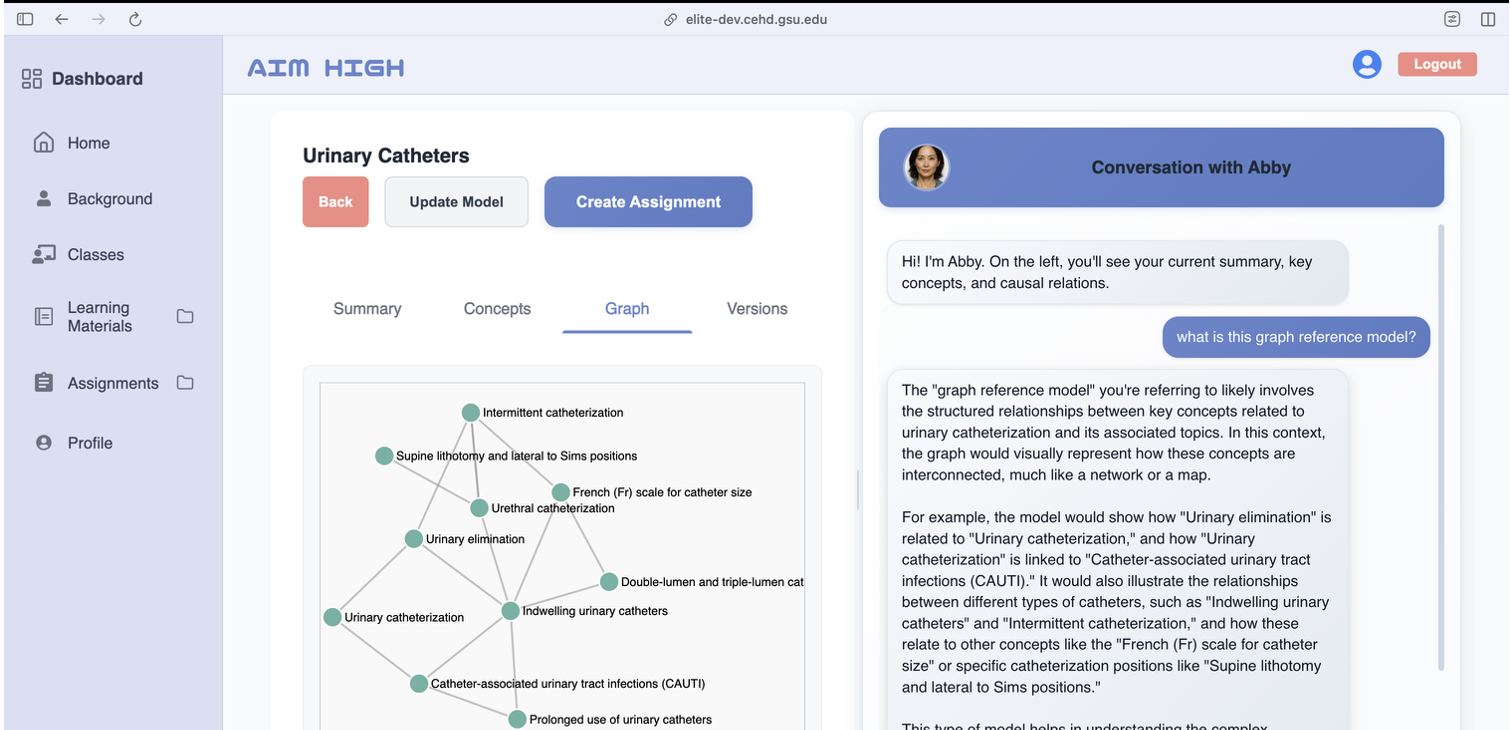
This Engaged Student Learning Level 1 project aims to serve the national interest by designing and implementing an Artificial Intelligence (AI)-augmented formative assessment and feedback system. This system will help students develop source-based STEM arguments, such as STEM text summarization, or problem spaces, which are mental representations of a problem and of multiple paths to solving it. This will be implemented in large, undergraduate introductory physics courses at an urban university that serves diverse and historically underrepresented student groups. Persistent learner engagement in pre-classroom learning activities is critical to learner success in introductory STEM courses. The innovation of the project will include AI-generated adaptive scaffolding information and learning progress feedback with data visualization techniques to help students with concept learning and self-regulatory behaviors. The unique learning opportunities supported by an AI-scaffolded feedback system will significantly increase students' engagement levels in self-paced online pre-classroom learning. This, in turn, will help students acquire content knowledge and build a proper understanding of problems to prepare themselves for success in in-classroom interactive problem-solving activities.
Kim, M., Bae, Y., Kim, J., Hoffmann, M., & Ahmadzadeh, S. (accepted). GenAI integration into an AI application through user-Engaged and use-inspired AI research. In N. Kim, M. Kim, A. Rand, & K. Comstock (Eds.), AI for, with, and by instructional design. The Association for the Advancement of Computing in Education (AACE).
Han, H.Kim, S., Abdeen, S., & Kim. M. (accepted). AI-Scaffolded Summarization in STEM: How do Students Differ in Writing and Revision?. In Proceedings of the 20th International Conference of the Learning Sciences - ICLS 2026. International Society of the Learning Sciences.
Kim, S., Han, H., & Kim. M. (accepted). Design principles for AI-supported chatbots to scaffold problem-based learning in undergraduate nursing education. In Proceedings of the 20th International Conference of the Learning Sciences - ICLS 2026. International Society of the Learning Sciences.